Puma's story begins not with a corporate decision or a market opportunity, but with a family argument. In the aftermath of the Second World War, two brothers from the Bavarian town of Herzogenaurach decided they could no longer work together. Rudolf and Adolf Dassler had built their father's shoe workshop into a business that supplied athletes across Europe. When they went their separate ways in 1948, both took a piece of the company, the town, and the future of football kit manufacturing with them.
Adolf founded Adidas. Rudolf walked across the river Aurach, set up a rival firm he initially called Ruda, and soon renamed it Puma.
A town divided
For decades the two companies existed in a state of cold war. Herzogenaurach was literally divided: workers from one factory did not enter the bars and restaurants favoured by the other. Local football clubs wore one brand or the other, never both. The rivalry was personal long before it became commercial, and the animosity between the Dassler brothers lasted until their deaths.
That founding tension shaped Puma's character. It was always the other German brand: fighting for shelf space, for athletes, for national team contracts, in the shadow of its larger neighbour from across the river. What it found, over the following decades, was that there was more than enough of the world to go around.
The German heartland
Puma's early foothold in football came from the Bundesliga. Borussia Mönchengladbach, one of the dominant clubs of the 1970s, became an early partner. The club won five Bundesliga titles between 1971 and 1977 in Puma kits. That relationship stretches back to at least 1974-75, with more than 118 Mönchengladbach shirts now in the ShirtSociety catalogue, the largest concentration of any era.
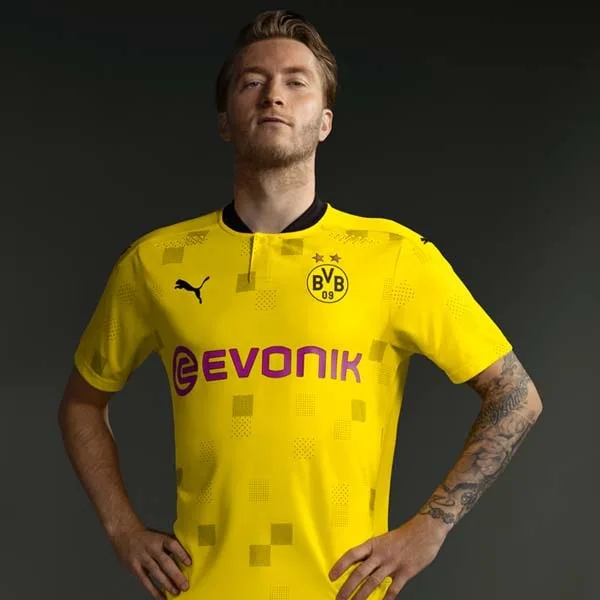
Werder Bremen and VfB Stuttgart built similarly long-running Puma associations during the same period. Fortuna Düsseldorf, another Bundesliga regular of the 1970s and 80s, added to a strong West German club base. Borussia Dortmund would later become Puma's flagship German club, a relationship now reflected in 163 shirts in the catalogue, the most of any single club.
Mexico 1970 and the Pelé moment
Puma's most famous moment in football took place before a ball was kicked. Minutes before kick-off of the 1970 World Cup final in Mexico City, Pelé crouched down on the pitch and asked the referee to wait while he re-tied the laces on his boots. Television cameras across the world zoomed in. The boots were Puma Kings.
Whether the bootlace moment was planned or spontaneous has been debated ever since, but the result was the same: Puma and the most famous player in the world shared a moment watched by hundreds of millions. The association helped establish Puma's identity in a sport where Adidas already had a significant head start.
Africa
If Adidas dominated European football for much of the 20th century, Puma built its broadest international presence in Africa. The brand became a consistent supplier to African national teams through their most formative competitive decades.
Senegal, Ghana, Morocco and Tunisia all have significant Puma histories reflected in the ShirtSociety catalogue. The African connection gave Puma something neither Adidas nor Nike could easily claim: a genuine presence at the heart of football cultures that were growing rapidly and producing players who would go on to define the game at European club level.
For collectors, African national team shirts from the 1990s and 2000s represent some of the most sought-after Puma pieces. Bold colours, distinctive Puma template designs and limited international availability have made them particular favourites.
European clubs: Lazio, Valencia and beyond
Beyond Germany, Puma established long partnerships with clubs across Europe. Lazio in Serie A have worn Puma kits across many of their most important seasons, with more than 100 shirts documented in the ShirtSociety catalogue. Valencia in Spain built a similarly long association, spanning 88 shirts across several decades of their history.
National team partnerships added further breadth. Austria leads the national team count in the catalogue with 102 shirts, reflecting one of Puma's most enduring international relationships. The Czech Republic, a Puma country through the Czechoslovakia era and into the present, contributes 67. Italy, with 66 shirts catalogued, has worn Puma kits during notable periods of their history. Uruguay, Switzerland and Paraguay complete a picture of a brand present across every major confederation.
The Premier League years
Puma's footprint in English football grew significantly in the 2010s. Arsenal wore Puma kits from 2014 to 2019, bringing the brand into weekly Premier League and Champions League visibility. The partnership produced some well-regarded designs and coincided with Arsène Wenger's final seasons at the club.
Manchester City followed, giving Puma a presence at one of European football's best-resourced clubs during a period of sustained Champions League competition. AC Milan, meanwhile, strengthened Puma's position in Serie A, adding one of the game's most recognisable clubs to a roster that already included Lazio and the German heavyweights.
The catalogue today
More than 4,670 Puma shirts from 183 clubs are catalogued by collectors on ShirtSociety, spanning from the mid-1970s to the current season. The range moves through six decades of design: the clean, understated kits of the early Bundesliga era; the bolder geometric patterns of the 1980s and 90s; the performance fabrics and sublimated prints of the 2000s; and the tighter, more technical silhouettes of the modern game.
Puma has never held the market dominance that Adidas and Nike have achieved at various points. But it has supplied some of the game's most important teams, produced some of its most collected shirts, and built an identity in football that is genuinely its own.
For a brand born out of a family argument in a Bavarian town, that is not a bad legacy.